
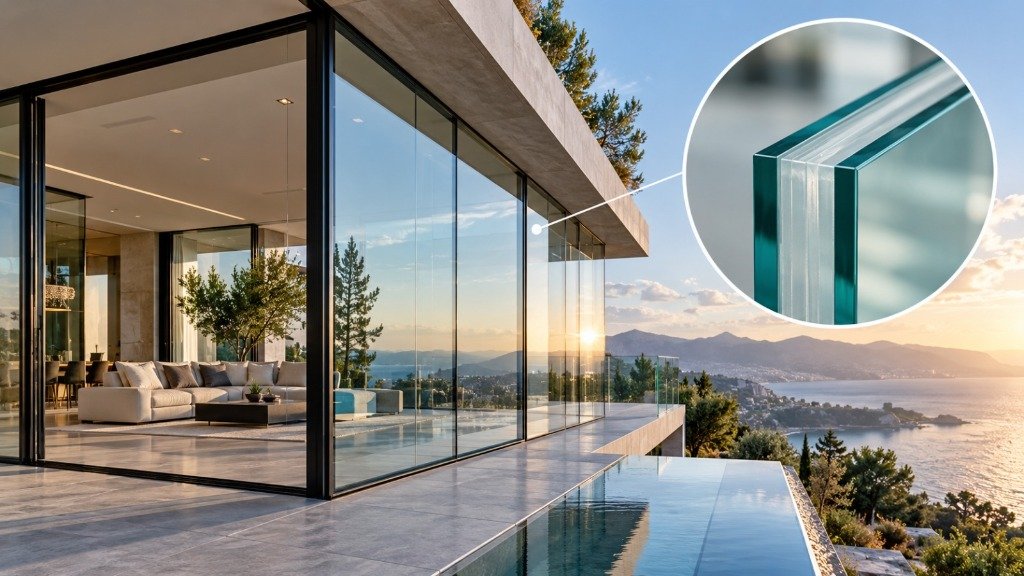
In modern architecture, glass is no longer just a passive windowpane designed to admit daylight; it is an active structural, acoustic, and safety envelope. As building designs incorporate larger uninterrupted spans—from soaring atrium skylights and structural facades to cantilevered balcony balustrades—the consequences of glass breakage become a critical life-safety parameter. While standard tempered glass offers high mechanical strength, it shatters into thousands of loose granular fragments when compromised.
Where structural integrity and fallout prevention are mandatory, laminated safety glass provides the definitive engineering solution. By permanently bonding two or more glass lites with an elastomeric polymer interlayer, laminated glass transforms brittle panels into composite, shatter-resistant architectural barriers.
What Is Laminated Glass?
Laminated glass is a composite safety glazing material produced by permanently joining two or more sheets of glass with one or more polymeric interlayers (typically EVA, PVB, or SGP) under controlled heat and pressure. When impacted or fractured, the glass fragments adhere firmly to the internal plastic interlayer, retaining the overall structural envelope, preventing hazardous glass fallout, and resisting penetrative breach.
Unlike monolithic glass sheets that break freely into hazardous shards or loose granular cubes, laminated glass functions as a cohesive multi-ply laminate. Even under destructive impact, the composite unit holds together, keeping the opening closed against weather, intrusion, and accidental fall hazards.
Working Principle: Why Laminated Glass Does Not Fall Out
The core engineering advantage of laminated glass lies in its post-breakage composite behavior. In monolithic glass, crack propagation is instantaneous and total. In laminated glass, impact energy is dissipated elastically through the interlayer:
Absorbs initial surface load, wind pressure, and exterior environmental impacts.
Provides high-shear adhesion and elastic energy absorption, binding fragments permanently upon failure.
Retains building envelope stability and stops hazardous debris from entering occupied spaces.
Even if both glass lites experience complete mechanical failure, the viscoelastic interlayer holds the sharp fragments tightly in place. The panel remains anchored within its glazing channel or structural fittings, maintaining an effective barrier until replacement can be safely executed.
Understanding Interlayers: EVA vs. PVB vs. SGP
The performance and longevity of architectural laminated glass depend fundamentally on the polymer interlayer selected. In the Indian climate, temperature swings and monsoon humidity make interlayer selection critical:
| Interlayer Type | Moisture Resistance | Post-Breakage Rigidity | Optimal Applications |
|---|---|---|---|
| EVA (Ethylene-Vinyl Acetate) | Exceptional (Cross-linked, zero moisture absorption) | Moderate to high elasticity; holds fragments firmly | Open-edge railings, exterior canopies, and decorative fabric laminated glass |
| PVB (Polyvinyl Butyral) | Hydrophilic (Edges must be protected from standing water) | Flexible; cracked panels may sag under self-weight | Fully four-sided framed windows, interior sound partitions, automotive glass |
| SGP (SentryGlas / Ionoplast) | Superior (Engineered for fully exposed edges) | Ultra-rigid (Up to 100x stiffer; panel stands upright post-breakage) | High-wind hurricane facades, structural glass stair treads, walk-on floors |
Why EVA Excels in North India
Because EVA forms a cross-linked thermoset bond, it does not absorb ambient atmospheric moisture. For balcony railings where top edges are exposed to rain and morning dew, EVA prevents unsightly edge delamination and fogging that commonly affect unprotected PVB edges.
Textile & Metallic Encapsulation
EVA has superior melt flow properties during thermal lamination, enabling the flawless encapsulation of architectural wire meshes, metallic weaves, and luxury fabrics without resin discoloration.
Laminated Annealed vs. Laminated Toughened Glass
A frequent specification error is treating all laminated glass as identical in strength. The mechanical resistance depends on whether the glass plies undergo heat tempering before lamination:
1. Laminated Annealed (Float) Glass
Fabricated by bonding standard float glass panes. While it retains broken shards, it has standard annealed mechanical strength and can crack under moderate impact or thermal stress. Can be field-cut if required. Best suited for interior partition acoustic panels.
2. Laminated Toughened (Tempered) Glass
Both glass panes are individually pre-cut, CNC-processed, and thermally tempered to achieve 4–5 times higher mechanical bending resistance before being laminated. Provides unmatched impact strength and fail-safe retention. Mandatory for all architectural railings, skylights, and overhead canopies.
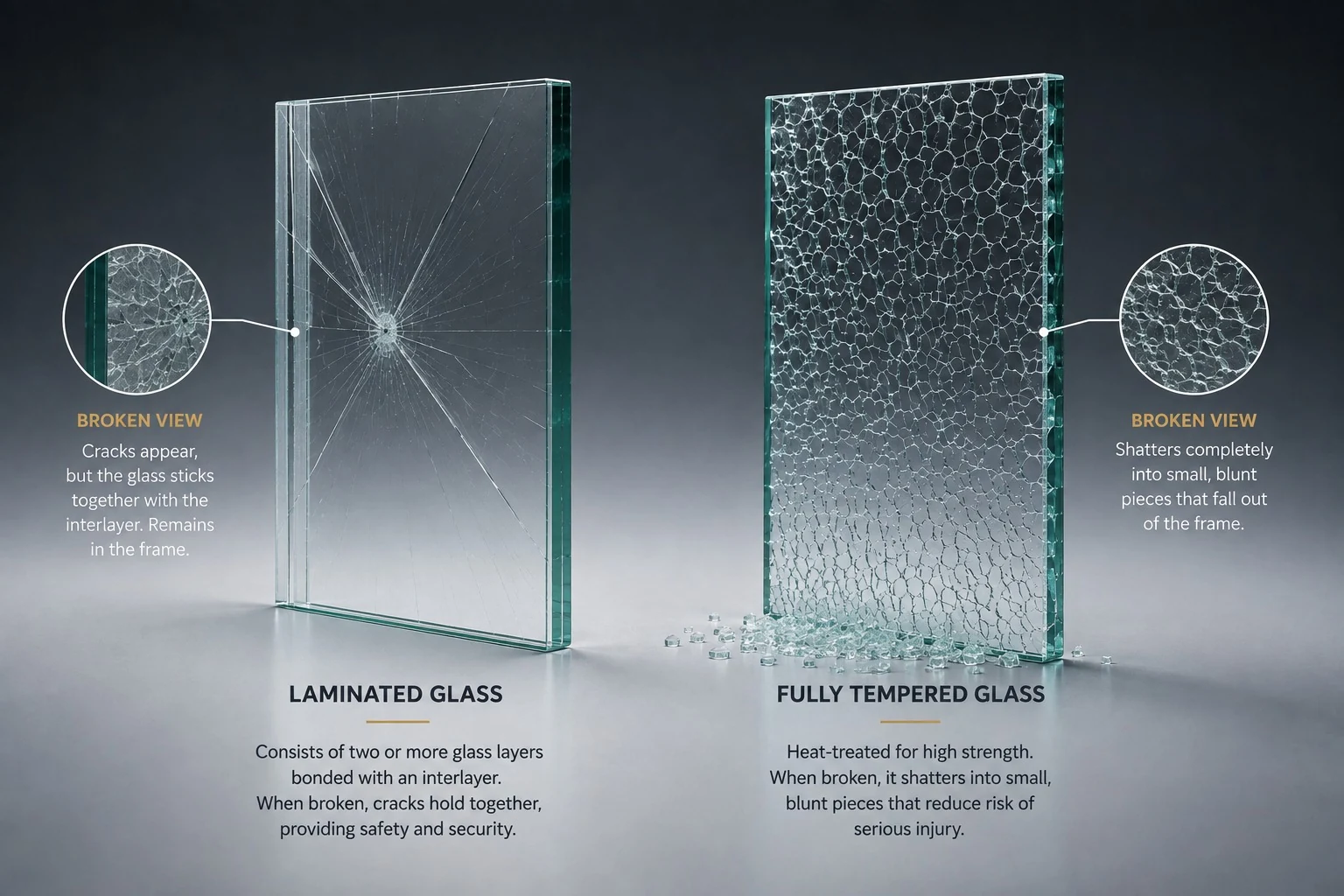
Laminated glass remains intact in the frame post-breakage, whereas monolithic tempered glass drops loose granular cubes.
Key Architectural Applications & Safety Considerations
Laminated safety glass is required wherever human impact, fall hazards, or falling debris present life-safety considerations:
Overhead Skylights & Canopies
Under NBC 2016 (Part 6, Section 8), monolithic glass is unsafe overhead. Laminated safety glass ensures that if thermal shock or falling objects fracture the pane, the glass cannot fall onto occupants below.
Balustrades & Balcony Railings
Railings act as life barriers. Laminated toughened glass ensures that even if one pane fractures, the remaining lite and interlayer maintain barrier containment to prevent fatal falls.
Acoustic Urban Glazing
Monolithic glass has a "coincidence dip" where traffic noise passes freely. The viscoelastic interlayer shears microscopically to convert sound energy into heat, providing quiet interiors.
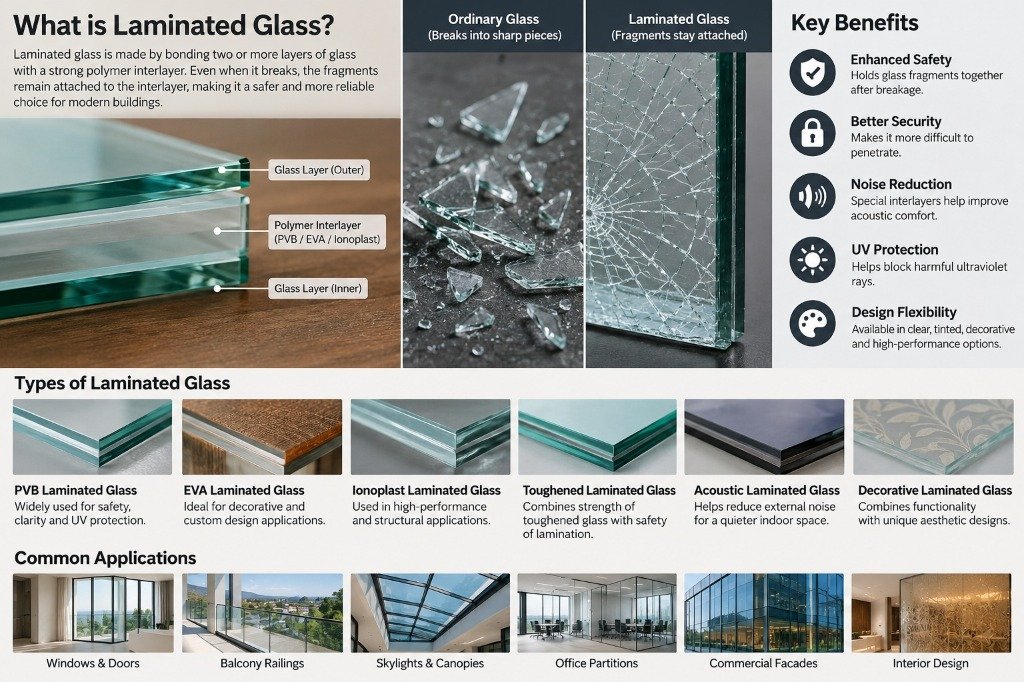
Structural laminated glass installed across exterior canopy spans and modern commercial balustrades.
Common Configurations & Thickness Guidelines
Architectural laminated glass thicknesses are specified as the sum of the glass plies plus the interlayer thickness. Common interlayer gauges include 0.38 mm, 0.76 mm, 1.14 mm, 1.52 mm, and 2.28 mm:
| Configuration (Plies + Interlayer) | Nominal Thickness | Typical Recommended Architectural Use Case |
|---|---|---|
| 4 mm + 1.52 + 4 mm | 9.52 mm | Premium interior acoustic partitions, framed residential windows |
| 5 mm + 1.52 + 5 mm | 11.52 mm | Framed low-rise balustrades, storefronts, and interior divider screens |
| 6 mm + 1.52 + 6 mm | 13.52 mm | Overhead canopies, skylights, and semi-frameless balcony railings |
| 8 mm + 1.52 + 8 mm | 17.52 mm | Cantilevered base-shoe frameless balcony balustrades, heavy facades |
| 10 mm + 1.52 + 10 mm | 21.52 mm | Public commercial railings, stadium barriers, high wind-load elevations |
| 12 mm + 1.52 + 12 mm | 25.52 mm | Structural glass floors, stair treads, high-security financial spaces |
Laminated Glass vs. Toughened Glass vs. DGU
Selecting the ideal safety glass requires matching performance attributes to your project's architectural demands:
| Parameter | Laminated Safety Glass | Monolithic Toughened Glass | Insulated Glass Unit (DGU) |
|---|---|---|---|
| Primary Role | Fallout protection, impact retention, acoustics | High mechanical bending strength & thermal resistance | Thermal insulation (U-value) & solar heat gain control |
| Post-Breakage State | Remains adhered to interlayer; retains opening | Shatters into small blunt dice; drops from opening | Depends on whether inner/outer panes are laminated |
| Acoustic Damping | Superior (Viscoelastic damping) | Moderate (Subject to coincidence dip) | Good (Cavity air gap isolation) |
| Thermal Insulation | Moderate (Solid conductive glass) | Low (Single pane heat transfer) | Superior (Hermetic cavity + Low-E coatings) |
| Ideal Usage | Canopies, railings, walk-on floors, high-security | Shower doors, frameless entry doors, interior walls (view toughened glass) | Exterior curtain walls, climate-controlled windows (view DGU glass) |
Frequent Procurement & Detailing Mistakes to Avoid
Using single 12 mm tempered glass for high-rise balconies is an unsafe economy. Spontaneous nickel-sulfide (NiS) inclusion or localized edge impact leaves an open drop. Laminated toughened glass ensures the barrier stays intact if one lite shatters.
Installing moisture-sensitive interlayers on frameless railings with unsealed top edges exposed to monsoons leads to edge cloudiness within a few seasons. Specify moisture-resistant EVA or SGP with machine-polished, arissed edges.
Once laminated toughened glass is fabricated, it cannot be cut, drilled, or edge-trimmed on site. All bracket holes, notches, and final site dimensions must be CNC-machined before tempering and lamination.
Architectural Precision: Shiva Glass Group Capabilities
At Shiva Glass Group, architectural safety glass is processed under strict quality control standards at our specialized manufacturing facility in Kohara, Ludhiana. Equipped with automated CNC glass cutting tables, high-pressure glass washing stations, and high-convection lamination chambers, we fabricate architectural safety glass tailored for North India's demanding conditions.
9.52 mm – 25.52 mm
Multi-ply architectural laminated configurations engineered for canopies, railings, and structural elevations.
Cross-Linked EVA
Premium EVA interlayers delivering optical clarity and moisture resistance for exposed exterior railings.
Studio Experience
Inspect full-scale mockups and material configurations at Studio Shiva Glass on Ferozpur Road, Ludhiana.
Frequently Asked Questions
What happens when laminated glass breaks?
When laminated glass fractures, the fragments remain firmly bonded to the internal polymer interlayer. The overall panel retains its barrier envelope, preventing sharp shards from falling and stopping accidental breach until replacement can be completed.
Is laminated glass better than toughened glass?
They serve different engineering functions. Toughened glass is 4 to 5 times stronger against surface impact and thermal stress. Laminated glass provides post-breakage fallout retention and acoustic damping, making it mandatory for railings, skylights, and overhead canopies.
Can laminated glass be cut after manufacturing?
Laminated annealed glass can be cut on site with specialized scoring techniques, but laminated toughened glass cannot be cut, drilled, or altered after fabrication. All sizing and holes must be completed prior to tempering and lamination.
Why does laminated glass sometimes get cloudy at the edges?
Edge cloudiness or delamination occurs when moisture penetrates unsealed edges, commonly seen with moisture-sensitive interlayers like standard PVB in exposed outdoor conditions. Cross-linked EVA or SGP interlayers eliminate this moisture ingress.
Does laminated glass reduce exterior traffic noise?
Yes. Laminated glass delivers superior acoustic insulation compared to monolithic glass of identical thickness because the elastomeric polymer interlayer shears microscopically to dampen sound vibration transfer.
Conclusion
Selecting the appropriate glass specification requires balancing aesthetic transparency with life-safety, acoustic comfort, and structural compliance. Whether designing an expansive atrium canopy, specifying frameless balcony balustrades, or insulating an executive boardroom from street noise, laminated safety glass provides dependable, high-performance architectural protection.
Explore Our Laminated Safety Glass Solutions
View certified specifications, available EVA thickness profiles (9.52 mm to 25.52 mm), and custom fabrication at Shiva Glass Group.